Hidden Water Leak Detection and Moisture Mapping in Longmont, CO
Front Range moisture assessment and emergency water-damage support to protect your property, reduce avoidable demolition, and guide the next right step.
When you need water leak detection Longmont CO property owners can rely on, you may be dealing with a high water bill but no visible leak, a wet wall, water under flooring, a ceiling stain, a musty odor, or an active water-loss emergency. Mont Long Restoration helps homeowners, landlords, HOAs, property managers, and businesses identify concealed moisture, document affected materials, and begin the appropriate drying or restoration plan.
With 16 years of local service experience, a team of 40 skilled professionals, 10 fully equipped service vans, and 24/7 emergency availability, we respond to water damage caused by burst pipes, appliance leaks, water-heater failures, overflowing toilets, roof leaks, irrigation issues, frozen pipes, and other unexpected water events across Longmont and the Front Range.
- Water leak detection and moisture mapping for residential and commercial properties
- Emergency water extraction, structural drying, and dehumidification support
- Documentation of moisture conditions, visible damage, and recommended next steps
- Available 24/7 for urgent water-loss events throughout Longmont and nearby Front Range communities
Request Water Leak Detection & Moisture Mapping
Fill out the form and we'll contact you immediately!
Water Leak Detection Backed by 16+ Years of Experience
Work with a local restoration team focused on clear answers, measured drying, and practical protection for your property.
Water damage is not always obvious. A small plumbing leak can move behind drywall, below flooring, through insulation, inside a ceiling cavity, or across a subfloor before visible damage appears. Mont Long Restoration combines water-damage mitigation, moisture assessment, structural drying, and reconstruction planning so property owners can make informed decisions without immediately opening every wall or removing every finish.
Our approach is built around evidence. We inspect accessible areas, compare moisture readings, evaluate visible signs of water migration, use thermal imaging as an investigative aid when appropriate, and recommend the next step based on the conditions found. Thermal imaging can help identify temperature differences that may indicate a moisture pattern, but it does not independently prove the leak source; readings and inspection help confirm what should happen next.
- 16+ years serving Longmont, Boulder County, and nearby Front Range communities
- 40 skilled restoration professionals and 10 equipped response vehicles
- 24/7 emergency availability for active water loss, flooding, burst pipes, and urgent drying needs
- Moisture documentation designed to help property owners understand affected materials and restoration options
Water Leak Detection Near Longmont Neighborhoods, Landmarks & Business Areas
Serving properties throughout Longmont, from Historic Eastside and Prospect New Town to commercial corridors near Main Street and Ken Pratt Boulevard.
A water leak can affect any type of Longmont property: an older home near Historic Eastside, a finished basement near McIntosh Lake, a townhome in Prospect New Town, a rental property near Downtown Longmont, or a commercial building along Main Street, Hover Street, or Ken Pratt Boulevard. Mont Long Restoration provides moisture assessment, water-damage mitigation, and structural drying support for homes, rentals, managed communities, offices, retail sites, restaurants, and other local properties.
Longmont's semi-arid Front Range climate creates a mix of water-loss concerns. Residents may experience frozen or burst pipes during a Colorado cold snap, roof leaks and ice-dam moisture during winter weather, irrigation or backflow-related leaks in warmer months, and indoor plumbing leaks that are first noticed through a meter alert, water bill increase, stained ceiling, warped floor, or unexplained odor.
- Longmont neighborhoods: Historic Eastside, Prospect New Town, Fox Hill, Clover Creek, Creekside, Meadowview, Rainbow Ridge, Quail Crossing, Southmoor Park, The Greens, Villas at Ute Creek, and nearby communities
- Nearby service areas: Boulder, Broomfield, Superior, Westminster, Thornton, Loveland, Fort Collins, Greeley, Arvada, Aurora, Denver, and surrounding Front Range locations
- Local landmarks and business areas: Downtown Longmont, Main Street Historic District, McIntosh Lake, Union Reservoir, St. Vrain Greenway, Prospect New Town, Longmont Museum, and major commercial corridors
Specialized Hidden Water Leak Detection for Walls, Floors, Ceilings & Crawl Spaces
Longmont moisture-mapping specialists focused on identifying affected materials before unnecessary removal begins.
A visible water stain is not always where the leak started. Water can follow framing, travel under flooring, wick into drywall, collect in insulation, move through ceiling cavities, or appear in a room away from the original source. That is why a suspected hidden water leak should be evaluated systematically rather than treated as a simple stain or cosmetic repair.
Mont Long Restoration focuses on water-damage assessment and mitigation. We identify accessible evidence of water migration, evaluate affected materials, map moisture patterns, and help define what needs drying, repair, removal, or further source investigation. If a plumbing source, irrigation line, roof issue, appliance failure, or underground service-line concern needs repair by another qualified trade, we help clarify that next step so your restoration plan is not based on assumptions.
- Moisture assessment for walls, ceilings, floors, crawl spaces, basements, cabinets, and adjacent materials
- Practical evaluation of water tracks, wicking, trapped moisture, and visible damage patterns
- Documentation that helps homeowners, property managers, and commercial owners understand the restoration scope
- Targeted recommendations designed to reduce unnecessary demolition while addressing materials that cannot be effectively dried
What Happens When a Hidden Water Leak Goes Unchecked in Longmont?
Small leaks can create larger drying, repair, and property-protection concerns when moisture remains trapped.
A concealed plumbing leak, appliance line failure, roof intrusion, toilet overflow, irrigation leak, or water-heater issue may cause damage before you see standing water. When moisture remains in drywall, insulation, wood framing, flooring, carpet padding, cabinetry, or ceiling materials, it can spread the restoration area and make repairs more complex.
A hidden leak does not automatically mean extensive demolition is required. However, it does mean the source and moisture spread should be assessed before repainting, replacing a single piece of trim, or assuming the area is dry. Moisture mapping helps establish where water has traveled and helps guide drying or removal decisions.
- Wet drywall may wick moisture upward from the floor or sideways from an adjacent room
- Hardwood, laminate, and subflooring can cup, buckle, swell, separate, or deteriorate after prolonged moisture exposure
- Insulation and enclosed wall cavities can retain moisture after visible water disappears
- Delayed drying can increase the risk of material deterioration and microbial-growth conditions
- Commercial properties may face tenant disruption, inventory exposure, business interruption, or larger restoration zones
When Should You Schedule Moisture Mapping After a Water Leak?
Know when a wet wall, high bill, meter movement, or hidden moisture concern needs professional evaluation.
You should schedule an assessment when you notice a condition that does not have a clear explanation or when an active water event may have affected hidden building materials. Many Longmont homeowners search for "why is my water bill so high," "water meter moving when everything is off," "wet spot in yard no rain," or "water in wall but no visible leak." These are symptom searches, and the right solution depends on what the inspection reveals.
| Situation | What It May Indicate | Recommended Next Step |
|---|---|---|
| Water bill suddenly increased | Running toilet, irrigation leak, appliance leak, hidden plumbing leak, or continuous water use | Turn off known water use and request evaluation if the source remains unclear |
| Meter moves when fixtures are off | Possible continuous water flow | Isolate irrigation if safe, recheck the meter, and arrange leak-source evaluation |
| Ceiling stain but no active drip | Past or intermittent plumbing, roof, appliance, or condensation issue | Schedule moisture assessment before cosmetic repair |
| Wet carpet but no visible leak | Water under flooring, appliance leak, wall moisture, or seepage | Avoid delaying drying and assess the affected area |
| Musty odor with no visible water | Trapped moisture or prior water damage | Request a moisture inspection and documentation |
| Warm spot on concrete floor | Possible hot-water line or slab-related concern | Arrange targeted leak/source evaluation |
| Soggy lawn with sprinklers off | Irrigation line, service line, drainage, or exterior plumbing issue | Shut off irrigation if possible and assess the source |
The City of Longmont advises customers to first stop active water use, ensure automatic fixtures and irrigation are off, and then observe the meter. If a dedicated irrigation shutoff is closed and meter flow stops, the leak may be outdoors. The City also uses advanced meters to identify continuous consumption and potential leaks.
- Schedule inspection promptly after a burst pipe, water-heater leak, appliance failure, overflow, or visible water intrusion
- Do not repaint, re-carpet, or close a wall until moisture conditions have been evaluated
- Isolate irrigation when safe if the issue may involve sprinklers, a backflow assembly, or an outdoor line
- Keep photos, utility notices, service records, and visible-damage documentation for your property file or insurance claim
Who Needs Water Leak Detection & Moisture Mapping in Longmont?
From single-family homes to multi-unit properties and commercial facilities across the Front Range.
Mont Long Restoration works with property owners and managers who need a clear, documented understanding of water intrusion or concealed moisture. Our services support immediate emergency response as well as planned assessments after a leak, high water bill, weather event, or suspected hidden moisture condition.
- Homeowners with wet walls, floors, ceilings, basements, crawl spaces, or unexplained utility increases
- Renters who need to report water damage promptly and protect belongings while coordinating with property management
- Landlords, HOA boards, and apartment communities managing shared plumbing, irrigation, and multiple affected units
- Retail stores, offices, restaurants, and hospitality properties experiencing active water loss or business disruption
- Schools, childcare facilities, churches, and community buildings requiring prompt water-damage assessment
- Medical offices, dental practices, laboratories, warehouses, and industrial properties with sensitive equipment or operations
- Property managers who need moisture documentation, mitigation coordination, and reconstruction planning across a portfolio
How Longmont Weather, Irrigation & Freeze-Thaw Cycles Affect Water-Loss Risks
Cold snaps, seasonal irrigation, snowmelt, storms, and changing water use can reveal hidden weaknesses.
Longmont properties face water-loss risks throughout the year. Winter freeze-thaw cycles can stress exterior faucets, irrigation components, backflow assemblies, exposed plumbing, and pipes in poorly insulated areas. Spring weather can reveal roof, window, drainage, or foundation moisture concerns. Summer irrigation use can make a broken sprinkler head, leaking valve, buried irrigation line, or backflow problem show up as a wet yard or a higher-than-normal water bill.
The City of Longmont treats continuous leakage and abnormal water use as a conservation concern. Its water-efficiency program notes that most customers have advanced meters that can monitor ongoing consumption and potentially identify abnormal use patterns.
Common Causes of Water Damage, Hidden Leaks & Moisture in Longmont Properties
Identifying the likely source helps guide the right drying, repair, and restoration plan.
Different water events create different restoration needs. A small appliance leak may saturate a kitchen cabinet base and nearby flooring. A toilet overflow may affect a bathroom floor, hallway, lower ceiling, or subfloor. A burst pipe can send water into multiple rooms within minutes. Moisture mapping helps identify the extent of affected materials, while additional plumbing, roofing, appliance, irrigation, or structural evaluation may be needed to confirm and repair the original source.
| Possible Source | Common Warning Signs | What Moisture Mapping Helps Assess |
|---|---|---|
| Appliance supply line | Water near a washer, dishwasher, refrigerator, or ice maker | Moisture in cabinets, walls, flooring, and adjacent rooms |
| Water heater leak | Pooling near tank, corrosion, wet utility-room floor | Water spread into nearby finishes, walls, and flooring |
| Toilet overflow or seal issue | Water near the toilet base, floor staining, odor | Affected flooring, subfloor, wall base, and lower-level ceiling areas |
| Burst or frozen pipe | Active water, low pressure, wet drywall, ceiling drip | Hidden wall or ceiling moisture and immediate drying needs |
| Roof leak or ice dam | Ceiling stain after rain or snowmelt | Moisture path through insulation, ceiling, and wall areas |
| Irrigation or backflow leak | Wet yard, pooling near exterior components, high bill | Whether water is isolated outdoors or affecting nearby structure |
| Sump-pump failure | Basement water, wet carpet, wet lower drywall | Water spread, material condition, and structural drying needs |
| Slab or concealed plumbing concern | Warm floor, unexplained moisture, water-running sound | Affected floor materials and the need for targeted source evaluation |
Our 6-Step Water Leak Detection & Moisture Mapping Process
Know what to expect when Mont Long Restoration arrives at your Longmont property.
Initial Call & Triage
We discuss the symptoms, whether water is still active, the affected rooms, safety concerns, and whether immediate extraction or containment is needed.
On-Site Visual Assessment
Our team evaluates accessible areas for standing water, staining, material changes, visible leaks, moisture paths, safety concerns, and signs of water migration.
Moisture Mapping & Diagnostic Readings
We take readings from relevant accessible materials, compare affected and unaffected areas, document moisture patterns, and use thermal imaging as a screening tool when appropriate.
Emergency Mitigation & Drying Plan
When mitigation is authorized and needed, we remove standing water, protect affected areas, place drying equipment, and develop a structural drying strategy.
Source-Repair Coordination & Restoration Recommendations
We explain whether conditions point toward a plumbing, appliance, roof, irrigation, drainage, or other source that needs qualified repair. We also identify materials that may be dryable, repairable, or likely to require removal.
Monitoring, Documentation & Follow-Up
We monitor drying progress when equipment is in place, document readings, provide applicable records, and discuss repair or reconstruction planning after mitigation.
Professional water-damage restoration relies on assessment, documentation, and appropriate drying procedures. ANSI/IICRC S500 describes procedures and precautions for water-damage restoration in residential, commercial, and institutional buildings.
What's Included in Our Water Leak Detection & Moisture Mapping Service
Clear findings and practical next steps for Longmont property owners and managers.
Every situation is different. The exact scope depends on whether water is active, where moisture is present, the accessibility of materials, the water source, and whether emergency drying is needed. Our goal is to provide understandable findings and a plan based on observed conditions.
- Initial phone triage and guidance for urgent water-loss situations
- Visual inspection of accessible affected rooms, surfaces, and materials
- Moisture measurements in relevant walls, ceilings, floors, trim, cabinetry, carpet, padding, or structural materials
- Comparative readings between suspected affected areas and dry reference areas
- Thermal-imaging screening when appropriate, followed by confirmation with moisture readings and inspection
- Photo documentation of visible water damage and affected materials
- Recommendations for emergency extraction, dehumidification, air movement, monitoring, removal, repair, or reconstruction
- Guidance on when a licensed plumber, roofer, irrigation specialist, or other source-repair professional may be needed
Key Advantages of Working with Mont Long Restoration
Restoration-grade assessment, drying coordination, and clear communication for Longmont properties.
Mont Long Restoration is built for property owners who need more than a quick visual check. Whether you are worried about a hidden plumbing leak, water under flooring, a ceiling stain, a wet basement, or a high bill with no visible leak, we help turn uncertainty into a documented next-step plan.
Water Leak Detection & Moisture Mapping Transformations for Longmont Properties
Understand what changes after concealed moisture is assessed, documented, and addressed.
A homeowner may initially see only a small stain, a wet baseboard, a warped plank of flooring, or an unexpectedly high water bill. A property manager may receive a tenant report about a musty odor or water beneath a sink. A business owner may notice moisture near a restroom, break room, mechanical room, or ceiling tile.
After assessment and mitigation, the goal is not simply to make the visible surface look better. The goal is to understand the extent of moisture, address the water source through the appropriate repair path, dry or remove affected materials properly, and create a practical plan for restoring the space.
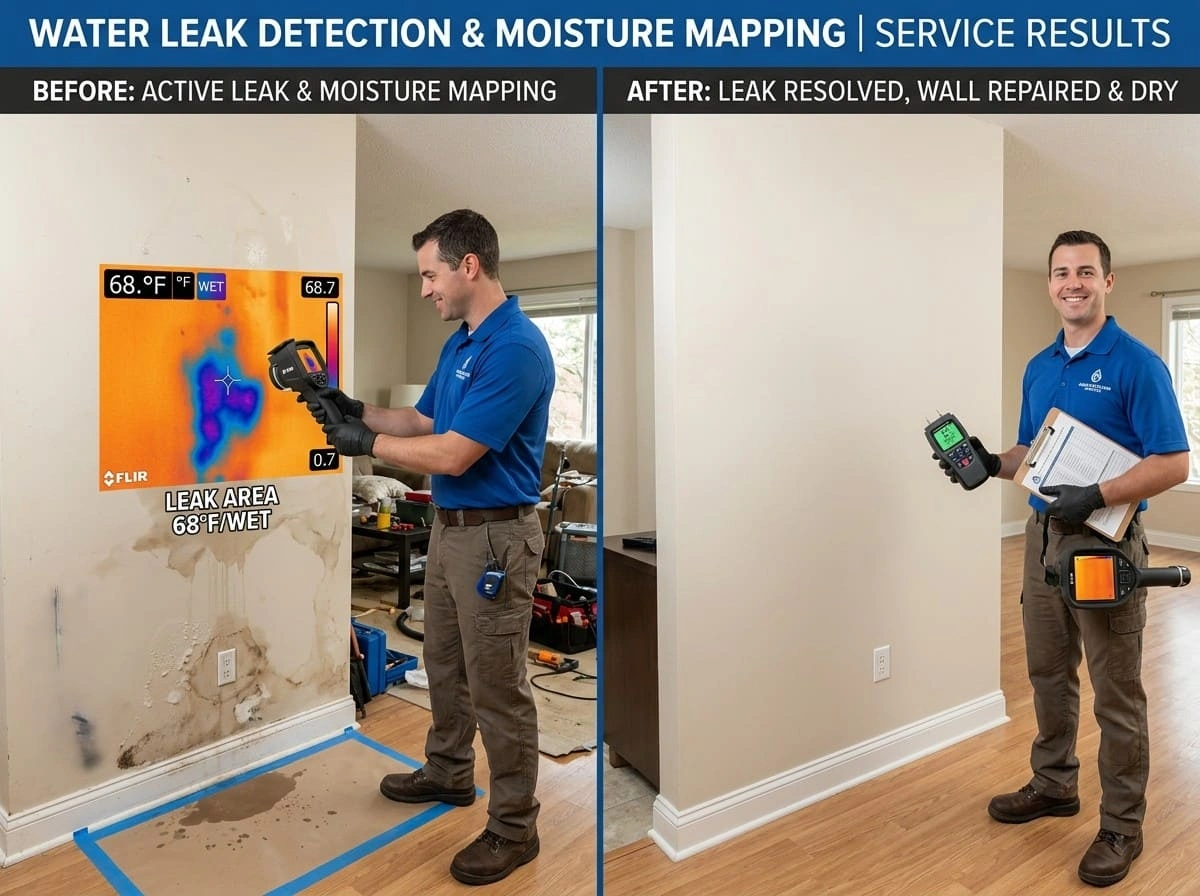
Before Assessment
- Unknown moisture conditions, hidden water tracks, and uncertainty about how far water spread
- Concern that every wall, floor, or ceiling must be opened
- Water-damage concern with limited records for an insurer, landlord, HOA, or property manager
- A water event disrupts a home or business without a recovery plan
After Assessment
- Documented readings, identified affected zones, and a clear drying or repair recommendation
- Targeted assessment designed to reduce unnecessary opening while addressing verified moisture
- Photos, assessment documentation, mitigation records, and defined next steps
- Emergency mitigation, monitored drying when authorized, and reconstruction planning where needed
How We Detect Hidden Moisture and Plan Water-Damage Drying
We use appropriate assessment tools to define the affected area and support informed restoration decisions.
Moisture mapping is a documented process of measuring and recording moisture conditions in building materials. It is different from simply locating a plumbing leak. Moisture mapping helps show where water has traveled, which materials are affected, and whether drying, removal, repair, or further source investigation may be appropriate.
| Tool or Method | How It Helps | Important Limitation |
|---|---|---|
| Visual inspection | Identifies staining, swelling, warping, water tracks, odors, and visible damage | Cannot reveal every concealed condition |
| Pin or pinless moisture meters | Measures moisture in accessible materials | Indicates moisture conditions; does not alone identify the original source |
| Thermal imaging | Helps identify temperature differences that may indicate an area for further evaluation | Detects surface-temperature variation, not moisture itself |
| Hygrometers and drying measurements | Help monitor humidity and drying conditions | Do not locate plumbing leaks by themselves |
| Water extraction | Removes accessible standing water | Must be followed by appropriate drying and source control |
| Air movers and dehumidifiers | Support controlled drying of affected materials and air | Require proper placement and monitoring |
| Targeted material access | Allows inspection or drying of concealed areas when justified | Should be limited to areas supported by assessment findings |
Thermal imaging is best used as a screening tool and should be supported by contact moisture readings and inspection. Industry guidance recognizes thermal imaging as a useful diagnostic method while emphasizing that infrared anomalies require confirmation rather than being treated as conclusive proof of moisture or a leak source.
Should Water-Damaged Materials Be Dried, Repaired, or Replaced?
Helping Longmont property owners choose the right path after a leak, overflow, or water intrusion event.
Whether a material can be saved depends on the water source, how long moisture was present, the type of material, degree of saturation, contamination level, structural condition, and measured drying response. A small clean-water event addressed quickly may allow some materials to be dried and repaired. Heavily saturated, deteriorated, contaminated, delaminated, or structurally compromised materials may require removal and replacement.
| Material or Condition | Drying or Repair May Be Appropriate | Replacement May Be Recommended |
|---|---|---|
| Lightly affected drywall | When clean-water exposure is limited, material remains stable, and readings respond to drying | When drywall swells, crumbles, remains wet, is contaminated, or shows significant deterioration |
| Carpet and padding | Some carpet may be cleaned and dried depending on water category, timing, and condition | Padding or carpet may require replacement after major saturation, contamination, or prolonged wetness |
| Hardwood flooring | Controlled drying may reduce damage when addressed promptly | Buckling, cupping, delamination, separation, or deep saturation may require replacement |
| Insulation | Limited situations depend on insulation type, access, and water source | Saturated or contaminated insulation often needs removal |
| Cabinet bases and trim | Drying and repair may be possible when materials remain stable | Swollen particleboard, delaminated finishes, or structural damage may require replacement |
| Ceiling materials | Drying and repair may be possible after limited clean-water exposure | Sagging, stained, structurally weakened, or contaminated materials may require removal |
- Materials are evaluated based on observed conditions, not assumptions
- Cosmetic repair should follow source control and verified drying
- Reconstruction recommendations should match the actual damage scope
- Water-damage repairs may be coordinated with plumbing, roofing, flooring, electrical, or other qualified trades as appropriate
Water Leak Detection & Moisture Mapping Costs in Longmont, CO
Clear cost drivers and practical estimates based on the actual condition of your property.
The cost of water leak detection, moisture mapping, emergency water removal, structural drying, and reconstruction depends on the situation. A small assessment in an accessible room is different from an after-hours burst pipe affecting several rooms, a finished basement, a crawl space, a commercial suite, or multiple units.
Mont Long Restoration provides clear scope information before authorized work begins. If an emergency condition requires immediate mitigation to limit further damage, we explain the recommended action and communicate the next steps as clearly as possible.
| Service Type | Common Cost Considerations |
|---|---|
| Moisture assessment | Number of affected rooms, material types, accessibility, and diagnostic needs |
| Emergency water extraction | Amount of standing water, affected square footage, timing, and access conditions |
| Structural drying | Equipment type, number of days, moisture severity, material response, and monitoring needs |
| Targeted demolition or removal | Material condition, access, contamination category, and required containment |
| Reconstruction | Drywall, flooring, cabinetry, paint, trim, ceiling, insulation, or structural repair requirements |
| Commercial water-loss response | Building size, affected zones, access windows, tenant coordination, equipment needs, and business-continuity planning |
- Active water-loss emergencies may require faster response and more immediate mitigation resources
- Clean-water, gray-water, and sewage-related conditions can require different cleanup procedures
- Commercial and multi-unit properties may benefit from phased work planning and coordinated access
- Insurance coverage, deductibles, exclusions, and claim payment are determined by the policy and insurer—not by the restoration contractor
Which Longmont Properties Need Professional Moisture Assessment?
If the source, spread, or condition of water damage is unclear, a documented assessment can help.
You may need professional assessment if you have a visible leak, suspect hidden water, experienced a recent overflow, received a high-bill notification, or want to know whether materials are still wet after a prior repair. The right response depends on the symptoms, not just the visible damage.
- You hear water running in a wall when fixtures are off
- Your water meter moves when no known water is being used
- Your Longmont water bill is much higher than normal with no visible explanation
- You see a wet spot in the yard when sprinklers are off
- You have a damp or warm spot on a concrete floor
- Water appears at the bottom of a wall, but there is no leak directly above it
- A ceiling stain remains after a roof, appliance, bathroom, or plumbing event
- Carpet, flooring, cabinets, baseboards, drywall, or insulation may have been exposed to water
- A backflow device, irrigation line, outdoor faucet, or sprinkler component leaks near freezing temperatures
- You need documentation for an insurance carrier, landlord, HOA, property manager, or commercial risk-management file
Water Leak Detection & Moisture Mapping for Longmont Commercial Properties
Protect operations, tenants, inventory, equipment, and building materials with a documented response plan.
Commercial water damage can affect far more than a single room. A leak above ceiling tiles, under a restroom, near a break room, beneath a mechanical space, or inside a multi-tenant building can interrupt daily operations and create wider property-management responsibilities.
Mont Long Restoration supports commercial property owners, facility managers, HOAs, landlords, and operations teams with moisture assessment, emergency mitigation, structural drying, and repair-planning coordination.
| Commercial Service | Description |
|---|---|
| Commercial moisture assessment | Evaluate accessible affected areas, document readings, and identify water migration concerns |
| Emergency water extraction | Remove standing water and begin initial mitigation for qualifying water-loss events |
| Structural drying & dehumidification | Develop a drying strategy for affected building materials and spaces |
| Multi-unit coordination | Support phased access, unit-by-unit assessment, and property-management communication |
| Documentation support | Provide photos, moisture records, mitigation information, and restoration scope details |
| Reconstruction planning | Coordinate repair priorities after mitigation and drying are complete |
- Office buildings, retail centers, restaurants, hotels, and hospitality facilities
- Medical, dental, educational, religious, and community-use properties
- Apartment complexes, condominiums, HOA communities, and mixed-use developments
- Warehouses, logistics facilities, manufacturing sites, and commercial campuses
- Property portfolios requiring clear communication, scheduled access, and organized records
Benefits of Hiring Water Leak Detection Professionals in Longmont
Better information helps protect your property, reduce uncertainty, and guide restoration decisions.
Professional assessment is valuable because visible water damage is often only part of the story. A wet area may extend beyond the stain, while other materials may be dry and not require removal. Moisture mapping helps distinguish between those conditions so restoration decisions can be more targeted.
- Identify wet building materials that may not be visible from the room surface
- Support faster drying and mitigation after a water-loss event
- Reduce unnecessary demolition by focusing attention on verified moisture conditions
- Document water-damage conditions for owners, managers, and insurance communication
- Help determine when source repair by a plumber, roofer, appliance technician, or irrigation specialist may be needed
- Create a clearer repair and reconstruction scope after mitigation is complete
- Protect business operations and property value through prompt, organized response
What Should You Do Before Help Arrives for a Water Leak?
Take safe, practical steps to limit further damage without creating additional hazards.
If water is actively entering your home or business, your first priority is safety. Do not take unnecessary risks to protect property. If you can safely reach a shutoff valve and stop the flow, do so. If water is near electricity, an electrical panel, outlets, appliances, or damaged ceilings, keep people away from the area and seek appropriate emergency assistance.
- Shut off the local fixture valve, irrigation shutoff, or main water supply only if you can do so safely
- If water is near electrical equipment, avoid touching outlets, switches, appliances, or electrical panels
- Move valuables, documents, and portable items away from water only when the area is safe to enter
- Do not use household vacuums to remove significant standing water
- Do not cut, drill, or open wet walls without considering hidden wiring, plumbing, insulation, and contamination concerns
- Avoid entering sewage-contaminated water or water from an unknown source without proper protective measures
- Notify your landlord or property manager promptly if you rent the property
- If water is running in the street, you suspect a main break, or you have widespread low pressure or no water service, contact the appropriate municipal utility resource
For City of Longmont customers, the City directs residents to report issues such as suspected main breaks, flooding, low pressure, no water service, and sewer backup concerns through Water Utilities during regular hours or the appropriate after-hours dispatch process.
Answers to Common Water Leak Detection Questions in Longmont
Practical answers for homeowners, landlords, property managers, and businesses.
How do I know if I have a hidden water leak in my Longmont home?
Common signs include an unusually high water bill, meter movement when fixtures are off, water-running sounds inside a wall, damp or warm flooring, ceiling stains, wet baseboards, warped floors, a musty odor, reduced water pressure, or unexplained water near a foundation or appliance. These symptoms do not all have the same cause, so an assessment helps identify the appropriate next step.
Why is my water bill high when I cannot see a leak?
A high bill can be caused by a running toilet, dripping fixture, irrigation problem, hidden supply-line leak, appliance issue, outdoor line problem, or continuous use. Start by ensuring fixtures and automatic water users are off, then check whether the meter continues to register flow. The City of Longmont advises closing a dedicated irrigation shutoff, if present, and checking the meter again; if flow stops, the issue may be outside.
Can you find a leak behind drywall without opening the entire wall?
We use visual inspection, moisture readings, thermal-imaging screening, and evidence from the affected area to narrow the concern. Sometimes targeted access is still needed to confirm a source or properly dry concealed materials, but moisture mapping can help avoid opening areas that do not show evidence of moisture.
Can thermal imaging detect moisture behind walls?
Thermal imaging can identify surface-temperature differences that may indicate an area requiring additional evaluation. It does not directly detect moisture or prove the source of a leak. We support thermal findings with moisture readings, inspection, and other appropriate diagnostic steps.
What is moisture mapping after a water leak?
Moisture mapping is the process of measuring and documenting moisture conditions in building materials. It helps show how far water has traveled through accessible walls, floors, ceilings, trim, insulation, carpet, or other materials and guides drying, removal, repair, and monitoring decisions.
Does a moisture meter tell you exactly where a leak started?
No. A moisture meter shows that material contains elevated moisture at the tested location. It does not automatically identify the original water source. The source may require plumbing, roofing, appliance, irrigation, drainage, or other evaluation.
Can you detect a water leak under concrete or flooring?
We can assess accessible moisture conditions around floors, walls, and adjacent materials and help identify whether the pattern warrants targeted source evaluation. A suspected slab leak, underground service-line leak, or plumbing issue may require a qualified plumbing leak-detection professional to confirm and repair the source.
Is a leaking backflow preventer an emergency?
A leaking backflow assembly can become urgent if water cannot be controlled, water is spraying or pooling near the structure, freezing weather is approaching, or the problem affects water service. If it is safe to do so, isolate the irrigation supply. If you cannot control the flow, call for urgent help and arrange qualified irrigation or plumbing repair.
Who is responsible for a leak between the water meter and my house in Longmont?
Responsibility depends on the location and the utility's determination. The City of Longmont states that property owners are responsible for maintaining the water service line from the property line to the home foundation. Water running in the street or a suspected main break may require City involvement, while a private service-line issue generally needs private repair.
What should I do if I hear water running when all faucets are off?
Stop known water users, including irrigation and automatic appliances where possible. Check for obvious fixture leaks, observe your water meter, and turn off the main water supply if there is active uncontrolled water or a suspected interior pipe failure. Arrange professional evaluation if the source is not clear.
Can a running toilet cause a large increase in my water bill?
Yes. A toilet that runs continuously or intermittently can waste a significant amount of water over time. A toilet should be checked as part of any high-water-bill investigation, along with irrigation, fixtures, appliances, and possible hidden leaks.
How do you know when water-damaged materials are dry?
Drying progress is assessed through measured readings, comparison to appropriate dry reference materials, material condition, humidity conditions, and ongoing evaluation. Visible dryness alone is not always enough to confirm that concealed building materials have reached an acceptable drying condition.
Do you help with insurance documentation after water damage?
Yes. We can provide applicable assessment records, photos, moisture documentation, mitigation details, invoices, and scope information. Insurance coverage depends on the cause of loss and the terms of your individual policy.
Clear Findings, Practical Recommendations & Responsive Support
Local guidance from the first assessment through drying, repair planning, and restoration coordination.
Mont Long Restoration approaches every water-loss situation with the goal of providing clear information, practical recommendations, and responsive support. We document accessible conditions, explain what our readings and observations mean, and help you understand the difference between source repair, emergency mitigation, structural drying, and reconstruction.
We do not promise that every leak can be identified without targeted access or that every affected material can be saved. Instead, we provide an evidence-based assessment and explain the options available for your specific property.
If authorized mitigation, repair, or reconstruction work includes written workmanship or manufacturer warranty coverage, the applicable terms will be explained with your service documentation.
Mont Long Restoration1205 S Main St
Longmont, CO 80501
United States
Credentials That Support Water Leak Detection & Moisture Mapping
Training and restoration knowledge matter when water affects building materials and indoor environments.
Water damage assessment and structural drying require more than a visual inspection. Moisture conditions, water source, material type, contamination concerns, equipment selection, and documentation all affect how a restoration project should be planned.
Mont Long Restoration's supplied qualifications include:
AMRT
Applied Microbial Remediation Technician
ASD
Applied Structural Drying
CR
Certified Restorer
WRT
Water Damage Restoration Technician
Class C License
Local Municipal / General Contractor License
These qualifications support a restoration-focused approach to moisture assessment, drying, mitigation, repair planning, and reconstruction coordination. Specific credential status, scope, and project applicability should be reviewed with the service team before work begins.
Emergency Water Leak Detection in Longmont, CO
Rapid help when active water, hidden moisture, or a sudden failure puts your property at risk.
Some water events cannot wait. An active burst pipe, overflowing fixture, failed appliance line, water-heater leak, saturated ceiling, toilet overflow, sump-pump failure, or major roof intrusion can spread quickly through walls, floors, ceilings, contents, and adjoining units.
Mont Long Restoration provides 24/7 emergency service availability for urgent water-damage conditions throughout Longmont and nearby Front Range communities.
- Immediate phone guidance to help assess urgency and safe containment options
- Dispatch planning for emergency extraction, moisture assessment, and drying needs
- On-site evaluation of visible water, affected materials, and potential migration paths
- Water removal, dehumidification, air movement, and structural drying when authorized and appropriate
- Documentation for property owners, managers, and insurance communication
- Follow-up recommendations for source repair, material removal, reconstruction, or additional specialty evaluation
Call now if you have active uncontrolled water, a burst pipe, flooding, sewage-related intrusion, water near electrical hazards, rapid ceiling saturation, or extensive wet flooring or walls.
Insurance Claim Assistance for Water Leaks & Moisture Damage
Organized documentation to help you communicate with your insurer, adjuster, property manager, or risk-management team.
A water-damage claim may require clear records of what happened, which materials were affected, what emergency steps were taken, and what mitigation or repair work was recommended. Mont Long Restoration helps property owners assemble relevant service documentation after a water-loss event.
- Initial assessment notes and visible-condition photos
- Moisture readings and affected-area documentation
- Emergency extraction, drying, mitigation, and equipment records when applicable
- Detailed invoices, authorized scope information, and repair recommendations
- Documentation that can be shared with insurers, adjusters, landlords, HOAs, or commercial property managers
- Direct-to-insurance billing support when available and authorized
Insurance coverage is determined by the cause of loss, your policy terms, exclusions, limits, endorsements, deductible, and the insurer's claim decision. Mont Long Restoration cannot guarantee coverage, bill adjustment, or claim payment.
Warranty Coverage for Leak Detection, Drying & Reconstruction Work
Understand applicable workmanship, material, and documentation terms before work begins.
Warranty coverage depends on the type of authorized work performed. Moisture assessment and emergency mitigation services provide documented findings and recommendations based on conditions observed at the time of service. Reconstruction, repairs, or installed materials may include separate workmanship or manufacturer coverage when stated in writing.
| Coverage Type | Description |
|---|---|
| Assessment documentation | Records of accessible conditions, readings, observations, and recommended next steps |
| Drying and mitigation scope | Documentation of authorized equipment, monitoring, and service activities where applicable |
| Workmanship | Any applicable written warranty on eligible authorized repair or reconstruction labor |
| Materials and products | Manufacturer warranty coverage for eligible installed products or components |
| Service records | Documentation that may help support future repair, maintenance, or claim conversations |
Warranty terms, exclusions, maintenance requirements, and time periods vary by service and material. Mont Long Restoration will explain applicable written terms for authorized repair or reconstruction work.
10 Fully Equipped Vehicles Serving Longmont & the Front Range
Response vehicles, drying equipment, and assessment tools prepared for water-loss events.
Mont Long Restoration operates with 10 fully equipped service vans to support water-damage assessment, emergency extraction, structural drying, containment, and restoration needs. Our response planning is designed to help us mobilize the people, equipment, and materials needed for qualifying emergencies across Longmont and nearby communities.
- Moisture meters, hygrometers, and thermal-imaging support tools for assessment
- Water-extraction equipment for standing-water removal
- Air movers, dehumidifiers, and drying equipment for structural drying plans
- Containment and protective materials for affected areas when needed
- Equipment and supplies for residential, commercial, and multi-unit water-loss conditions
- Dispatch coordination for urgent calls across Longmont and surrounding Front Range service areas
Flexible Payment Options for Eligible Water-Damage Reconstruction Projects
Helping property owners plan for restoration and rebuilding needs beyond emergency mitigation.
A water-damage event may require more than extraction and drying. When eligible reconstruction work involves drywall, flooring, cabinetry, trim, ceilings, insulation, paint, or larger structural repairs, Mont Long Restoration can discuss available payment and financing options for qualifying projects.
- Options for eligible repair and reconstruction projects
- Support for larger residential, multi-unit, or commercial restoration scopes
- Clear discussion of costs, project phases, and payment expectations before authorized work begins
- Coordination between mitigation, drying completion, and reconstruction planning
Financing availability, terms, project eligibility, lender requirements, and approval decisions may vary.
Community-Focused Water-Damage Restoration Service
A commitment to responsive service, organized restoration work, and property protection.
Mont Long Restoration is built around helping Longmont property owners respond to water-loss events with clear communication, practical assessment, and coordinated restoration support. Our focus is on protecting homes, businesses, tenants, building materials, and property operations when water damage creates uncertainty.
The business information provided identifies the following recognition and service distinctions:
Angi Super Service Award
Boulder County Gold Award
Longmont Area Chamber of Commerce Business of the Year
Nextdoor Neighborhood Fave
The Best of Longmont Award
Recognition, program criteria, award years, and availability may vary. Service quality should always be evaluated based on the needs of the property, the written scope of work, and clear communication throughout the project.
Senior & Military Discounts on Eligible Water-Damage Services
Supporting qualifying Longmont seniors, active-duty military members, veterans, and their families.
Mont Long Restoration offers special-discount opportunities for qualifying senior, military, and veteran customers on eligible water-damage restoration, moisture assessment, drying, and related restoration services.
Discount availability, service eligibility, exclusions, dollar amounts, and promotion periods may vary. Ask our team about current options when scheduling service.
Water Leak Detection & Moisture Mapping Hours in Longmont, CO
24/7 emergency availability for urgent water-loss response, extraction, and drying support.
Water leaks, overflows, burst pipes, appliance failures, and flood conditions do not follow regular business hours. Mont Long Restoration offers 24/7 emergency service availability throughout Longmont and nearby Front Range communities.
| Day | Hours |
|---|---|
| Monday | 00:00–23:59 |
| Tuesday | 00:00–23:59 |
| Wednesday | 00:00–23:59 |
| Thursday | 00:00–23:59 |
| Friday | 00:00–23:59 |
| Saturday | 00:00–23:59 |
| Sunday | 00:00–23:59 |
What Should You Look for in a Longmont Water Leak Detection Company?
Choose a provider that explains the process, documents findings, and helps you plan the next step.
When you have hidden moisture or water damage, the right provider should do more than identify a stain. Look for a team that can explain what is known, what still needs source evaluation, what materials are affected, and what mitigation or reconstruction work may be appropriate.
| What to Look For | Why It Matters |
|---|---|
| Emergency response availability | Active water can spread quickly and increase the restoration scope |
| Moisture measurement and documentation | Helps identify affected materials and track drying progress |
| Clear explanation of limitations | Thermal imaging and moisture readings should guide investigation, not create unsupported certainty |
| Residential and commercial experience | Different property types require different access, communication, and restoration planning |
| Extraction and structural drying capability | Water removal alone is not always enough to dry walls, floors, ceilings, and cavities |
| Insurance documentation support | Organized records can help owners communicate with insurers and adjusters |
| Repair and reconstruction coordination | Helps transition from mitigation to rebuilding after drying is complete |
| Written scope and authorization | Clarifies services, costs, responsibilities, and next steps |
Mont Long Restoration combines water-damage assessment, moisture mapping, emergency mitigation, structural drying, and reconstruction planning to help Longmont property owners move from uncertainty toward recovery.
Contact Mont Long Restoration for Water Leak Detection & Moisture Mapping in Longmont, CO
Speak with a water-damage restoration professional about hidden moisture, active water, drying needs, or the next step for your property.
If you are unsure whether you have a hidden plumbing leak, are dealing with wet drywall or flooring, noticed a sudden water-bill increase, experienced an overflow, found moisture in a basement or crawl space, or need urgent extraction and drying, Mont Long Restoration is ready to help.
Contact Mont Long Restoration
(720) 438-7100
montlongrestoration@gmail.com
1205 S Main St
Longmont, CO 80501
United States
24/7 Emergency Service Available
Current Special Offers
- Free Structural Moisture Assessment
- Flat-Rate 24/7 Emergency Dispatch
- Deductible Relief Discount
- Direct-to-Insurance Billing Promo
- Extraction & Reconstruction Bundle Credit
Protect your home, business, building materials, and recovery plan with professional water leak detection Longmont CO property owners can count on from Mont Long Restoration.