Burst Pipe Water Damage Cleanup in Longmont, CO
A burst pipe can flood a room in minutes and leave water inside walls, beneath flooring, above ceilings, or in a crawlspace long after the visible puddle is gone. Mont Long Restoration provides emergency burst pipe water damage cleanup in Longmont, CO, with water extraction, moisture mapping, structural drying, damage documentation, and repair/reconstruction coordination for homes, businesses, HOAs, and property managers.
If it is safe to do so, shut off the water at the main valve or local fixture valve first. Keep clear of water near electrical outlets, appliances, exposed wiring, or a sagging ceiling. Then call Mont Long Restoration at +1 (720) 438-7100 for urgent water removal and a clear drying plan.
Front Range Burst Pipe Cleanup to Protect Your Property and Limit Further Damage
A broken supply line, frozen pipe, water-heater connection, toilet hose, laundry line, irrigation manifold, or exterior hose bib can create a fast-moving water loss. Our Longmont water damage restoration team helps locate affected materials, extract standing water, assess hidden moisture, place drying equipment, monitor drying progress, and document the work performed.
Call Now for Burst Pipe Water Damage CleanupCall +1 (720) 438-7100 for 24/7 emergency water extraction and burst-pipe cleanup in Longmont and surrounding Boulder County communities.
- Emergency water removal for homes, apartments, offices, retail spaces, and commercial facilities
- Moisture inspection for wet drywall, flooring, ceilings, insulation, carpet, and crawlspaces
- Structural drying and dehumidification after clean-water, gray-water, or contaminated-water losses
- Clear mitigation scope, documented findings, and repair/reconstruction coordination
Request Emergency Burst Pipe Service
Fill out the form and we'll contact you immediately!
16+ Years of Emergency Water Damage Restoration Experience
Calm, organized response for burst-pipe water damage throughout Longmont, Boulder County, and the Front Range.
When water is coming through a ceiling, soaking carpet, pooling around a water heater, or spreading from a frozen line, property owners need practical guidance not vague promises. Mont Long Restoration provides a calm, organized response for burst-pipe water damage throughout Longmont, Boulder County, and the Front Range.
We focus on what matters first: stopping ongoing damage after the source has been controlled, identifying where water traveled, and creating a documented drying plan for the affected structure and contents. Visible water removal is important, but it is not the same as confirming that materials behind walls, below flooring, inside insulation, or within ceiling cavities are dry.
Local Coverage
Serving Longmont, Boulder County, and surrounding Front Range communities
40 Professionals
40 skilled professionals and 10 equipped service vans, as provided by the business
24/7 Response
24/7 emergency response for urgent water-damage conditions
Complete Scope
Water extraction, moisture mapping, structural drying, contents protection, and reconstruction coordination
All Property Types
Residential, commercial, HOA, multi-family, and property-management support
4.9/5 Rating
Rated 4.9/5 based on 8,647 customer reviews
Water Damage Restoration Across Longmont and Boulder County
Serving homes, apartments, commercial spaces, and managed properties across the Front Range.
Mont Long Restoration serves properties across Longmont, including Old Town and Historic Eastside areas, Prospect New Town, Fox Hill, Clover Creek, Meadowview, Rainbow Ridge, Quail Crossing, Southmoor Park, The Greens, Villas at Ute Creek, and nearby communities.
Whether a pipe bursts in a home near Downtown Longmont, an apartment close to Main Street, a commercial space near Prospect, or a property near McIntosh Lake, the immediate objective is the same: stop the water source, protect people and belongings, remove standing water, assess hidden moisture, and dry the property correctly.
We also support property owners and managers in nearby Front Range communities, including Boulder, Broomfield, Westminster, Thornton, Arvada, Aurora, Denver, Greeley, Loveland, Fort Collins, Lakewood, Superior, Centennial, Castle Rock, Commerce City, and Parker.
Longmont Neighborhoods We Serve
Nearby Service Areas
Local Property Types We Support
- Older homes and newer subdivisions
- Multi-family housing
- Retail suites and mixed-use developments
- Offices and professional suites
- Warehouses and industrial spaces
- HOA-managed properties
Specialized Water Extraction, Moisture Mapping, and Structural Drying
Professional emergency water mitigation focused on affected materials, moisture migration, and documentation.
A burst pipe can send water far beyond the obvious leak location. Water can travel under flooring, behind baseboards, into wall cavities, down through ceiling assemblies, into insulation, and across adjoining rooms. A mop, household fan, or shop vacuum may help with a small and safe surface spill, but it cannot confirm whether the underlying building materials are dry.
Mont Long Restoration performs professional emergency water mitigation with a focus on affected materials, moisture migration, drying conditions, and documentation. Our work is designed around a structured restoration process: assess the loss, identify moisture, extract water, establish a drying plan, monitor progress, and document the completed mitigation scope.
- Moisture assessment for walls, ceilings, floors, crawlspaces, cabinets, and adjoining rooms
- Water extraction from carpet, padding, hard surfaces, and accessible affected materials
- Structural drying with appropriate air movement and dehumidification equipment
- Clear recommendations when materials can be dried, repaired, removed, or require reconstruction
- Documentation for property owners, managers, and insurance claim files
Professional water-damage restoration standards address loss assessment, water categorization, drying principles, contents and structural considerations, monitoring, and final inspection.
Hidden Moisture Can Continue Damaging Your Property After the Leak Stops
Water can travel beyond the visible wet area into walls, ceilings, crawlspaces, and contents.
The most urgent step is stopping the water source. After that, the remaining concern is where the water traveled and how long materials remained wet. A burst pipe may affect carpet padding, hardwood flooring, drywall, baseboards, insulation, subfloors, cabinets, ceilings, contents, and crawlspaces—even when the surface appears mostly dry.
A water loss can also create safety concerns. Avoid entering standing water near electrical equipment or outlets. Leave the room if a ceiling is bulging, sagging, or actively dripping heavily. If the leak involved sewage, a toilet overflow with contamination, or outdoor floodwater, do not treat it as a simple clean-water cleanup.
- Wet drywall, insulation, and ceiling cavities may retain moisture after surface water is removed
- Carpet can feel dry on top while the pad or subfloor remains wet underneath
- Wood flooring may cup, swell, buckle, stain, or loosen depending on water exposure and drying conditions
- Water inside a crawlspace or wall cavity can create odors, material deterioration, and delayed repair needs
- Contaminated water requires different precautions, cleaning, containment, and disposal decisions than a clean supply-line leak
- A pipe repair stops the source, but water-damage mitigation addresses the moisture left behind
Do not assume every loss requires demolition or full reconstruction. The appropriate scope depends on the water source, affected materials, contamination conditions, duration of exposure, accessibility, moisture readings, and the structure's response to drying.
First Steps for Longmont Homes and Businesses
Act quickly but safely when a pipe, appliance connection, fixture supply line, ceiling, or wall is actively leaking.
If water is actively coming from a pipe, appliance connection, fixture supply line, ceiling, or wall, act quickly but do not take unnecessary risks.
Shut Off the Water If Safe
Use the local shutoff valve if you know the affected fixture, or turn off the main water supply. The City of Longmont advises residents to turn off the main shutoff valve after a burst pipe and leave faucets open until repair is completed.
Stay Away from Electrical Hazards
Do not walk through water near outlets, extension cords, appliances, electrical panels, or exposed wiring. If a ceiling is bulging or sagging, leave the area below it.
Call the Source-Repair Professional
A plumber, HVAC professional, roofer, appliance specialist, or irrigation technician may be needed to repair the failed source. Mont Long Restoration can begin mitigation once the flow is stopped or controlled.
Move Belongings If Safe
Relocate electronics, documents, rugs, furniture, and valuables away from wet areas. Avoid moving saturated items through dry areas without containment.
Document the Damage
Take photos and video of the water source, affected rooms, wet materials, and damaged belongings before major cleanup, when it is safe to do so.
Call Mont Long Restoration
We can assess moisture, extract water, protect affected materials, establish drying equipment, and document the mitigation work. Call +1 (720) 438-7100.
If multiple neighbors have low pressure, no water, or similar conditions, or if water appears to be coming from a public main or meter area, contact the City of Longmont rather than assuming the problem is inside the property. City notices about local main breaks state that affected areas may experience low pressure, discolored water, or short periods without water service.
Fast Action Can Reduce Drying Time, Material Loss, and Disruption
Burst-pipe emergencies are stressful because the situation changes quickly.
A small pinhole leak can become a ceiling leak. A frozen pipe can split during a cold snap but not begin leaking until it thaws. A washing-machine hose can release water across flooring and into adjacent rooms before anyone sees it.
Emergency water extraction and structural drying are intended to limit secondary damage after the source is stopped. The faster standing water is removed and hidden moisture is identified, the more opportunity there may be to preserve affected materials when conditions allow.
- Stop water flow before attempting extensive cleanup
- Avoid using household equipment around unsafe electrical conditions
- Do not puncture a sagging ceiling unless directed by a qualified professional and conditions are safe
- Do not rely on a dehumidifier alone for widespread water intrusion
- Do not close doors, cover wet materials, or trap moisture without assessing ventilation and drying needs
- Do not discard damaged materials or contents before documenting them if an insurance claim may be involved
Mont Long Restoration helps Longmont property owners understand what is affected, what can reasonably be dried, what may need removal, and what information should be documented before reconstruction begins.
Prepare Your Longmont Property Before the Next Front Range Freeze
Reduce the chance of another emergency with practical seasonal preparation.
A burst-pipe cleanup page should also help property owners reduce the chance of another emergency. Longmont's Front Range weather can bring sharp temperature changes, hard freezes, snowstorms, and freeze-thaw cycles that place exposed plumbing and exterior components under stress.
Before winter, locate the main water shutoff valve, disconnect garden hoses, protect exterior hose connections, winterize irrigation systems as appropriate, and address known leaks or poorly insulated pipe runs. Longmont's winter guidance recommends disconnecting hoses, shutting off irrigation water, and blowing out sprinkler systems before cold weather creates freeze risk.
| Prevention Task | Why It Matters | Best Timing |
|---|---|---|
| Find and label the main shutoff valve | Helps stop water faster during an active leak | Before winter and after moving into a property |
| Disconnect outdoor hoses | Reduces freeze pressure at hose bibs and exterior plumbing | Before freezing weather |
| Shut down or winterize irrigation | Helps protect sprinkler lines, irrigation manifolds, and backflow components | Before sustained freezes |
| Protect exposed pipes | Reduces risk in crawlspaces, garages, utility rooms, and exterior walls | Before cold snaps |
| Repair slow leaks | Helps prevent weak fittings or corroded connections from worsening | As soon as discovered |
| Maintain safe indoor temperatures | Helps protect vulnerable pipes during cold periods | Throughout winter |
Most homes do not need an annual "burst-pipe certification," but seasonal preparation is practical. If your property has an irrigation system, backflow preventer, vacant unit, unheated garage, exposed crawlspace, or previous freeze damage, create a winter shutdown and inspection plan before the next cold snap.
Water-Damage Recovery for Homes, Businesses, and Managed Properties
Mont Long Restoration supports both residential and commercial clients throughout Longmont and surrounding Boulder County communities.
Any property with an active or recent plumbing-related water loss may need professional mitigation if water has spread beyond a small, contained, easily dried area. Mont Long Restoration supports both residential and commercial clients throughout Longmont and surrounding Boulder County communities.
- Single-family homes and townhomes
- Apartments, condominiums, and multi-family properties
- HOAs and community associations
- Rental homes and property-management portfolios
- Restaurants, cafes, breweries, and food-service facilities
- Offices, retail spaces, medical practices, and mixed-use buildings
- Schools, churches, community centers, and nonprofit facilities
- Warehouses, industrial spaces, and commercial properties with mechanical systems
Commercial properties often face additional concerns such as tenant coordination, business interruption, inventory protection, after-hours access, records for insurers, and phased reconstruction planning. Our team can coordinate drying and mitigation work around the property's layout, occupancy, and operational needs.
Front Range Weather, Seasonal Use, and Freeze-Thaw Cycles Matter
Longmont properties experience conditions that can expose weak plumbing connections and exterior systems.
Cold snaps can freeze water in vulnerable pipes. Warming weather can reveal a crack after a frozen line thaws. Seasonal irrigation startup can expose a damaged manifold, sprinkler line, or backflow component. A detached garage, unheated utility room, exterior wall, crawlspace, or hose bib may be more vulnerable than interior plumbing.
Winter
Hard freezes can affect exposed lines, exterior hose connections, irrigation components, garage pipes, and crawlspace plumbing.
Spring
Thawing and irrigation startup can reveal freeze damage, cracked fittings, or failed backflow assemblies.
Summer
Increased water use, irrigation demand, appliance use, and water-heater activity can expose worn supply lines or connections.
Fall
Winterization is the time to disconnect hoses, protect exterior plumbing, locate shutoff valves, and prepare irrigation systems.
If water is pooling near an irrigation manifold, backflow preventer, exterior spigot, or water meter, the cause may differ from an indoor supply-line failure. A qualified source-repair professional can address the failed component, while Mont Long Restoration can assess and dry any resulting property damage.
Which Plumbing Failures Can Flood a Longmont Property?
Not every "burst pipe" looks like a pipe spraying inside a wall.
Some losses begin with a slow drip, a leaking supply hose, a damaged water-heater connection, a frozen exterior line, or a pressure-related fitting failure.
| Common Source | What You May Notice | Areas Often Affected |
|---|---|---|
| Frozen supply line | No water, weak water pressure, water in a wall, or a leak after thawing | Walls, ceilings, garages, crawlspaces |
| Toilet supply hose | Water near the toilet or spreading across the bathroom floor | Flooring, baseboards, adjacent rooms |
| Water-heater leak or failed connection | Water around the mechanical room or water heater | Utility rooms, basements, stored contents |
| Washing-machine supply line | Water behind the appliance or across the laundry floor | Laundry room, flooring, walls, adjacent spaces |
| Dishwasher or refrigerator line | Slow or sudden water near cabinets or appliances | Kitchen flooring, cabinets, walls |
| Exterior hose bib | Leak after freezing weather or hose-related pressure buildup | Exterior wall, garage, basement, wall cavity |
| Irrigation manifold or backflow device | Outdoor pooling, pressure problems, or visible exterior leaks | Landscaping, exterior walls, utility areas |
| Ceiling pipe failure | Dripping, staining, a ceiling bubble, or sagging drywall | Ceiling cavity, insulation, rooms below |
What to Expect When Mont Long Restoration Arrives
A clear process helps reduce uncertainty during an emergency.
Emergency Call and Initial Assessment
We gather information about the source, affected rooms, active water flow, visible damage, and immediate safety concerns. We explain what to do before help arrives when it is safe to act.
Source-Status Confirmation & Site Safety Review
Before restoration begins, the water source should be stopped or controlled. We identify visible hazards, evaluate the affected area, and determine whether a plumber, utility provider, roofer, HVAC technician, or other source-repair professional is needed.
Water Extraction & Contents Protection
We remove accessible standing water and take reasonable steps to protect affected contents, flooring, furniture, and materials based on the conditions of the loss.
Moisture Mapping & Damage Assessment
We inspect affected walls, ceilings, floors, insulation, crawlspaces, cabinets, and adjoining spaces for moisture migration. This helps identify water that is not obvious from the surface.
Structural Drying & Dehumidification
We establish a targeted drying plan using appropriate equipment and methods for the structure and materials involved. The goal is controlled drying, not simply placing fans in a wet room.
Monitoring, Documentation & Reconstruction Planning
We monitor drying progress as appropriate, document the mitigation work, and explain the next steps for repairs, selective removal, contents handling, or reconstruction coordination.
A Clear Scope for Water Extraction, Drying, and Documentation
The scope depends on the water source, how long water flowed, the amount of moisture, and the materials affected.
Every loss is different. The scope depends on the water source, how long water flowed, the amount of moisture, the materials affected, access conditions, contamination concerns, and the property's layout. Mont Long Restoration explains the recommended work before major non-emergency stages begin.
A Typical Burst-Pipe Mitigation Scope May Include
- Emergency assessment of affected rooms, materials, and visible hazards
- Water extraction from hard surfaces, carpet, padding, and accessible areas
- Moisture inspection of walls, ceilings, floors, cabinets, baseboards, crawlspaces, and adjacent rooms
- Documentation of affected areas, moisture conditions, and equipment placement where applicable
- Placement of air movers, dehumidifiers, and other drying equipment as appropriate
- Structural drying and monitored moisture reduction
- Contents protection, limited pack-out coordination, or moving assistance where included in the approved scope
- Selective removal recommendations for unsalvageable or contaminated materials
- Coordination with plumbing, roofing, HVAC, appliance, irrigation, or reconstruction professionals when needed
- Insurance-related documentation support, subject to authorization and policy requirements
Emergency Equipment, Moisture Documentation, and Clear Communication
Built to support emergency water removal, moisture assessment, drying, and recovery coordination.
Burst-pipe damage requires more than a general cleaning approach. Mont Long Restoration is built to support emergency water removal, moisture assessment, drying, and recovery coordination for Longmont residential and commercial properties.
Our goal is to give property owners a clear picture of the situation: where the water went, which materials need attention, what work is recommended, and what comes next. We do not assume every wet material must be removed, and we do not assume a dry-looking surface means the structure is dry.
- Emergency water extraction and mitigation support
- Moisture mapping and targeted structural-drying planning
- Air movement and dehumidification equipment for approved drying scopes
- Documentation for owners, property managers, and insurance claim files
- Coordination with source-repair professionals and reconstruction planning
- 24/7 availability for urgent Longmont water-damage conditions
From Active Water Intrusion to a Documented Drying Plan
Replace uncertainty with documented information and a practical plan.
A burst pipe can leave property owners unsure whether flooring, walls, ceilings, insulation, cabinets, and personal belongings can be saved. The purpose of professional mitigation is to replace uncertainty with documented information and a practical plan.
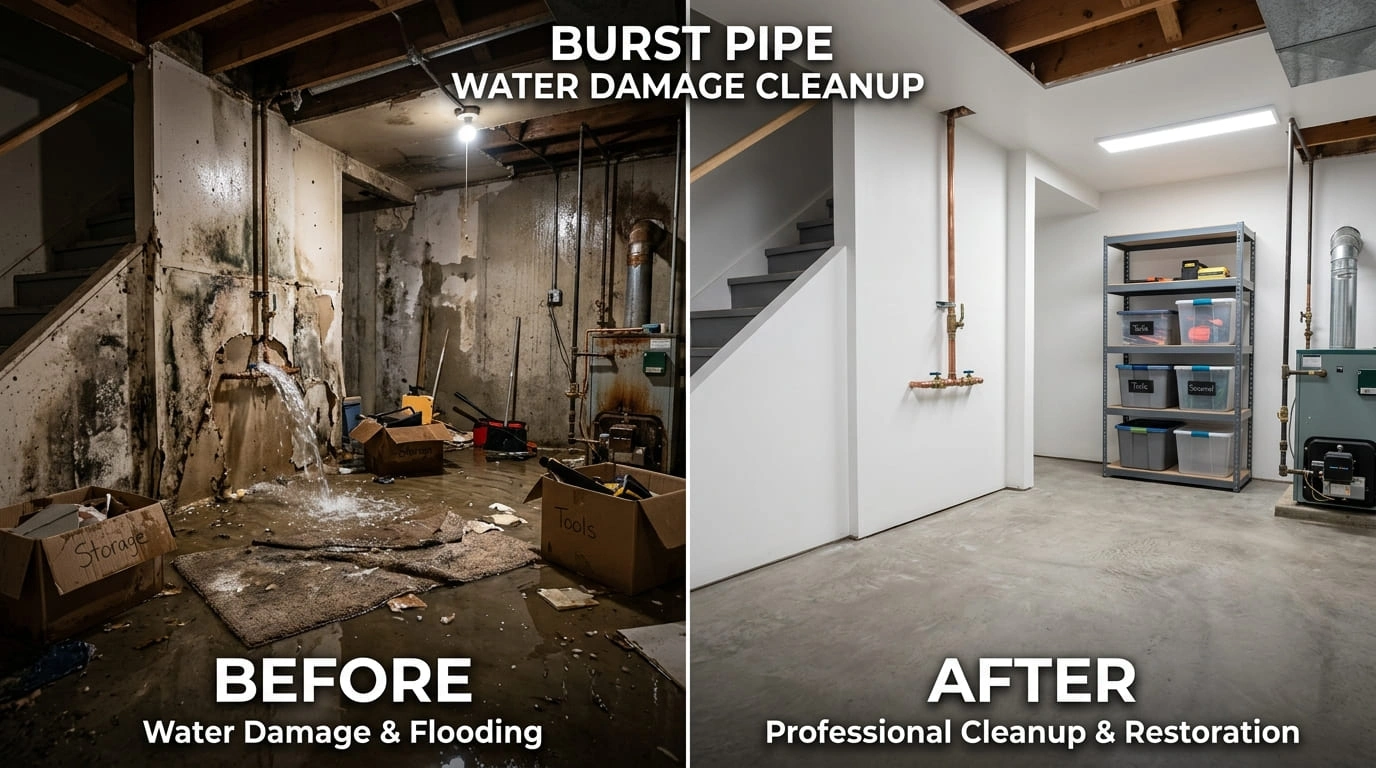
Before Cleanup
Water may still be active or recently stopped. Carpet may be wet, and water may be under hardwood or laminate flooring.
After Assessment
Standing water is extracted from accessible areas, and affected materials are evaluated through visual inspection and moisture assessment.
Before Cleanup
Drywall, ceiling materials, and insulation may contain hidden moisture. Property owners may not know whether the source was a frozen pipe, supply hose, fixture, appliance, or exterior component.
After Assessment
A drying plan is established for the conditions present, and moisture progress is documented where monitoring is part of the scope.
Before Cleanup
Documentation may be incomplete for an insurer or property manager.
After Assessment
The owner receives a clearer path for source repair, material decisions, and reconstruction.
Water Extraction, Moisture Mapping, Drying, and Controlled Recovery
The right method depends on the source, spread, materials, contamination conditions, and access limitations.
Mont Long Restoration approaches each water loss according to the source, spread, materials involved, contamination conditions, and access limitations. The right method for a clean-water supply-line leak is not automatically the same as the method for a toilet overflow, sewage backup, outdoor floodwater intrusion, or contaminated loss.
Professional Water-Damage Restoration May Involve
- Extraction equipment for standing water and wet carpet or padding
- Moisture meters and related inspection tools to help identify water migration
- Air movers and dehumidifiers to support controlled structural drying
- Targeted drying of wall cavities, ceilings, floors, crawlspaces, and affected structural areas when appropriate
- Material removal only when drying is not feasible, materials are deteriorated, or contamination conditions require a different approach
- Containment and worker-protection measures when water conditions or affected materials warrant them
- Ongoing monitoring and final condition review when included in the mitigation scope
For water that is Category 2 or Category 3, recognized guidance indicates remediation and appropriate contamination controls should occur before restorative drying. The water category, source, contamination level, and affected materials must be evaluated on-site; never assume all burst-pipe water is clean or safe to handle.
How We Help Longmont Property Owners Make Material Decisions
The final recommendation depends on the actual conditions observed—not a one-size-fits-all rule.
Not every affected material has the same salvage potential. A fast response can improve the chance of drying certain materials, but the final recommendation depends on the actual conditions observed—not a one-size-fits-all rule.
| Material or Area | May Be Dryable or Repairable When | May Need Removal or Replacement When |
|---|---|---|
| Carpet and carpet pad | Water is clean, exposure is limited, and drying can be achieved | Pad is heavily affected, water is contaminated, odor persists, or drying targets are not reached |
| Drywall | Wetting is limited, material remains stable, and moisture can be controlled | Drywall swells, crumbles, remains wet, is contaminated, or traps inaccessible moisture |
| Hardwood flooring | Water is removed promptly and materials stabilize during drying | Boards cup, buckle, stain, delaminate, or subfloor moisture remains elevated |
| Insulation | Material is minimally affected and can be appropriately evaluated | Insulation is saturated, compacted, contaminated, or unable to dry effectively |
| Cabinets | Water exposure is limited and structural integrity remains sound | Swelling, delamination, odor, persistent moisture, or material breakdown is present |
| Ceilings | Leakage is limited and materials remain secure | Ceiling material sags, loses integrity, crumbles, or creates a safety concern |
We explain recommendations in plain language and provide a written scope before major work proceeds whenever conditions allow.
Clear Cost Factors and No-Pressure Scope Explanation
The cost depends on the actual loss, not just the visible puddle.
The cost of burst pipe water damage cleanup depends on the actual loss, not just the visible puddle. A small, contained clean-water leak may require limited extraction and drying. A pipe that runs overnight through a ceiling, wall, crawlspace, or finished basement may affect multiple rooms, structural materials, contents, and reconstruction needs.
Key Cost Factors Include
- How long water flowed before the source was stopped
- Number of rooms, levels, and materials affected
- Whether water traveled into walls, ceilings, subfloors, insulation, crawlspaces, or cabinets
- Water source and contamination conditions
- Amount of extraction, drying equipment, monitoring, and labor required
- Emergency or after-hours conditions
- Accessibility of affected areas
- Contents protection, packing, storage, or specialized cleaning needs
- Selective demolition, material removal, mold remediation, or reconstruction requirements
- Whether separate source repair is needed from a plumber, HVAC technician, roofer, appliance professional, or irrigation specialist
Mont Long Restoration provides an assessment-based recommendation and explains the mitigation scope before major non-emergency work begins. Ask for a written breakdown of recommended services, especially when the loss involves multiple rooms, commercial space, or insurance documentation.
When Water Damage Requires More Than a Towel, Mop, or Household Fan
Professional water mitigation is more appropriate when water has entered building materials or multiple rooms.
A small splash from a fixture may be manageable if it is contained, clean, and thoroughly dried immediately. Professional water mitigation is more appropriate when water has entered building materials, affected multiple rooms, reached electrical areas, traveled through a ceiling or wall, pooled in a crawlspace, or remained wet for an unknown period.
Call for Professional Help When You Have
- Water leaking from a wall, ceiling, basement, crawlspace, utility room, or garage
- A burst or frozen pipe that soaked flooring, drywall, insulation, cabinets, or furniture
- Wet carpet and padding, water under flooring, swollen baseboards, or a musty odor
- A ceiling bubble, sagging ceiling, or visible water stain that is growing
- Water near outlets, appliances, electrical equipment, or an electrical panel
- A toilet supply hose, washing-machine line, water-heater connection, or appliance line failure
- Water from a potentially contaminated source
- A vacant property, multi-unit property, HOA common area, rental unit, office, restaurant, retail suite, or warehouse
- Uncertainty about whether the water has spread behind walls or below flooring
Water Removal and Structural Drying for Longmont Businesses and Multi-Unit Properties
Coordinated response for owners, facility managers, maintenance teams, landlords, HOAs, and property managers.
A burst pipe in a commercial property can affect operations, inventory, equipment, tenant spaces, customer access, and safety procedures. Mont Long Restoration supports commercial water damage restoration for offices, retail properties, restaurants, apartment communities, warehouses, medical spaces, hospitality properties, and managed facilities.
We work with owners, facility managers, maintenance teams, landlords, HOAs, and property managers to establish an organized response and provide appropriate documentation.
| Commercial Service | How It Supports Recovery |
|---|---|
| Emergency water extraction | Removes accessible standing water from floors, carpet, and affected areas |
| Moisture mapping | Helps identify hidden water in walls, ceilings, floors, and adjoining suites |
| Structural drying | Supports recovery of affected building materials where feasible |
| Contents and inventory protection | Helps reduce further exposure to furniture, equipment, documents, and inventory |
| Documentation support | Provides records of visible conditions, mitigation activity, and recommended next steps |
| Reconstruction coordination | Helps transition from mitigation to repair planning after drying is complete |
Commercial property owners may need phased work, after-hours access, tenant communication, safety controls, or coordination with multiple trades. We tailor the response to the building's occupancy, access, affected systems, and approved scope.
Protect Your Property With a Documented Drying Process
More than water removal—a complete recovery process.
Professional water-damage mitigation provides more than water removal. It helps property owners understand what is wet, which materials may be affected, how drying will be managed, and what repair decisions may be needed after the emergency.
- Identify water that may be hidden behind walls, below flooring, or inside ceilings
- Remove standing water and reduce the time materials remain wet
- Establish drying conditions appropriate to the property and water-loss circumstances
- Help protect salvageable building materials and contents when conditions permit
- Document affected areas and mitigation activity for property records or insurance claims
- Separate source repair from water-damage mitigation so the recovery process is clear
- Reduce uncertainty for homeowners, property managers, tenants, businesses, and insurers
- Provide a practical path from emergency response through drying and reconstruction coordination
Why DIY Cleanup Can Become Unsafe
Water, electricity, contamination, and hidden damage can create serious hazards.
DIY cleanup may be reasonable for a small, contained clean-water spill that is quickly stopped and fully dried. It becomes risky when water reaches electrical equipment, building cavities, ceilings, large floor areas, porous materials, or potentially contaminated sources.
Do Not Take Unnecessary Risks With
- Standing water near outlets, appliances, extension cords, or electrical panels
- A sagging, bulging, cracking, or actively leaking ceiling
- Sewage, toilet overflow contamination, outdoor floodwater, or unknown water sources
- Wet drywall, insulation, carpets, and structural materials that may contain hidden moisture
- Frozen pipes, pressurized lines, or plumbing repairs beyond your experience
- Large losses that spread into crawlspaces, walls, ceilings, or multiple rooms
Safety Notice: If there is an immediate life-safety emergency, call 911. For a suspected municipal water-main break, widespread low pressure, no water service, or flooding originating from outside the property, contact the appropriate City of Longmont service rather than attempting private repair.
Answers to Common Longmont Burst-Pipe Questions
Practical answers for homeowners, property managers, and businesses.
What should I do first when a pipe bursts in my Longmont home?
If it is safe, shut off the water at the local valve or main water supply. Avoid water near electrical outlets, appliances, panels, or a sagging ceiling. Take photos when safe, move valuables away from wet areas, and call a source-repair professional and a water-damage restoration provider.
Do I call a plumber or water damage restoration company first?
Often, both may be needed. A plumber or appropriate trade professional repairs or controls the failed pipe, appliance connection, irrigation component, roof, or other source. A restoration company extracts water, identifies hidden moisture, dries affected materials, and documents the water damage. If the water is actively flowing, source control comes first.
Can restoration begin before the pipe is permanently repaired?
Mitigation can often begin once the water flow is stopped or controlled. The permanent repair should be handled by the appropriate source-repair professional. The exact sequence depends on the leak, safety conditions, access, and scope of damage.
How do you know whether water is behind drywall or under flooring?
Professional inspection may include visual evaluation, moisture assessment, review of water pathways, and testing of affected materials. Water often moves beyond the visible wet area, particularly under flooring, behind baseboards, inside wall cavities, and through ceiling assemblies.
Can wet carpet be saved after a burst pipe?
Sometimes. Salvage depends on the water source, contamination conditions, length of exposure, carpet and pad condition, subfloor moisture, and whether drying can be completed effectively. Contaminated water or severely affected padding may require removal.
Can hardwood floors be saved after water damage?
Some hardwood flooring can be dried or stabilized if water is removed promptly and moisture is managed effectively. However, cupping, buckling, staining, delamination, prolonged wetness, and subfloor damage may change the recommended repair approach.
Why is water coming through my ceiling after a pipe burst?
Water may be collecting in a ceiling cavity from a pipe, appliance line, bathroom fixture, upper-floor plumbing connection, or other source above. Keep clear of the area if the ceiling is sagging or bulging, and avoid electrical hazards.
Does homeowners insurance cover burst pipe water damage in Colorado?
Coverage depends on your policy, cause of loss, maintenance history, exclusions, endorsements, deductible, occupancy conditions, and the insurer's decision. Mont Long Restoration can provide documentation of observed conditions and mitigation work, but cannot guarantee coverage or interpret your policy.
Can you help with insurance claim documentation?
We can provide relevant mitigation documentation, such as photos, moisture-related records where applicable, work scope information, and invoices. You should contact your insurer or agent for coverage decisions and claim instructions.
How much does burst pipe cleanup cost in Longmont?
Cost depends on the source, amount of water, number of rooms, affected materials, contamination category, emergency conditions, equipment required, contents involvement, and reconstruction needs. A professional assessment is the most reliable way to understand the necessary scope.
What if I have low water pressure or no water from a city issue?
If neighbors have similar issues, water is pooling near public infrastructure, or there is widespread low pressure or no service, contact City of Longmont Water Utilities or the designated after-hours city contact. City main-break notices explain that low pressure, discolored water, or temporary loss of water can occur during repairs.
Why did my pipe start leaking after the freeze ended?
A pipe can freeze and crack while temperatures are low but may not visibly leak until ice thaws and water flow returns. This is common with exposed plumbing, exterior connections, garages, crawlspaces, and vulnerable wall cavities.
Clear Information, Documented Work, and Responsive Support
A practical, transparent recovery process for Longmont property owners.
Mont Long Restoration is committed to a practical, transparent recovery process. We explain the role of source repair, water extraction, moisture assessment, structural drying, material decisions, and reconstruction coordination so property owners know what to expect.
If a repair, installation, or reconstruction element carries a manufacturer or workmanship warranty, the written terms, limits, duration, exclusions, and maintenance requirements should be provided with the approved work scope. Water-damage conditions vary, so no responsible restoration company should promise that every material can be saved, every insurance claim will be paid, or every loss will require the same solution.
Mont Long Restoration
1205 S Main St
Longmont, CO 80501
United States
Training and Credentials for Water Damage Recovery Work
Specialized knowledge for water-damage mitigation and reconstruction.
Water-damage restoration requires knowledge of moisture behavior, affected materials, contamination conditions, drying principles, structural considerations, and documentation. Mont Long Restoration's business information identifies the following qualifications and operational specializations:
AMRT
Applied Microbial Remediation Technician
ASD
Applied Structural Drying
CR
Certified Restorer
WRT
Water Damage Restoration Technician
Class C License
Local Municipal / General Contractor
Operational Specializations
- Mold remediation and environmental stabilization
- Water-damage mitigation and emergency extraction
- Reconstruction and structural rehabilitation
- Sewage cleanup and biohazard decontamination
Credentials, licensing, insurance coverage, certification status, and service scope should be confirmed for the specific project before work begins.
Emergency Water Extraction When a Pipe Fails
A burst pipe does not wait for regular business hours.
Mont Long Restoration offers 24/7 emergency support for water-damage situations in Longmont and nearby Front Range communities.
When you call, the initial focus is to understand whether water is still flowing, whether there are immediate electrical or structural hazards, which rooms are affected, and whether source repair needs to be coordinated before mitigation begins.
Emergency Response May Include
- Immediate phone guidance for safe water shutoff and hazard avoidance
- Assessment of affected rooms, materials, visible water, and moisture migration
- Emergency water extraction from accessible affected areas
- Initial drying and dehumidification planning
- Guidance on source repair coordination with a plumber or appropriate trade
- Documentation of observed damage and mitigation work
- Recommendations for ongoing drying, material decisions, and reconstruction planning
Documentation to Help You Navigate the Water-Damage Claim Process
Organized information for your property records and claim file.
A burst-pipe loss can create questions about photos, inventory, mitigation authorization, estimates, repair decisions, and communication with an insurance carrier. Mont Long Restoration helps document the mitigation portion of the event so you have organized information for your property records and claim file.
Documentation May Include
- Initial photos of visible water damage and affected areas
- Notes regarding the reported source and observed conditions
- Moisture assessment records where applicable
- Water-extraction and drying-equipment documentation
- Mitigation scope, invoices, and recommended next steps
- Repair or reconstruction recommendations after drying is evaluated
- Information requested by an authorized adjuster or property representative
Insurance coverage depends on the actual policy, cause of the loss, endorsements, exclusions, maintenance history, deductible, insurer review, and claim decision. Mont Long Restoration does not guarantee insurance coverage, approve claims, or provide legal or insurance-policy advice.
Understand Workmanship and Product Coverage Before Repairs Begin
Different providers, scopes, and warranty terms may apply.
Water mitigation, source repair, drying, reconstruction, and replacement materials may involve different providers, scopes, and warranty terms. Mont Long Restoration explains the scope of its work and provides applicable written warranty information for approved repair or reconstruction work.
| Coverage Type | What It May Include |
|---|---|
| Workmanship coverage | Written terms for eligible repair or reconstruction labor |
| Product or material coverage | Manufacturer coverage for qualifying installed materials or products |
| Mitigation documentation | Records of the approved extraction, drying, monitoring, and mitigation work |
| Reconstruction scope | Written details of repairs, materials, completion expectations, and applicable terms |
Warranty terms can vary by service, material, manufacturer, water conditions, maintenance requirements, and the approved project scope. Review the written agreement for the specific work performed.
10 Equipped Service Vans Supporting Longmont and the Front Range
Equipment matched to the property, water source, and drying plan.
Mont Long Restoration's business information identifies a fleet of 10 fully equipped service vans to support emergency water damage restoration across Longmont and nearby communities. Equipment needs vary by property type, water source, affected materials, access conditions, and drying plan.
Our Emergency Response Capability May Include
- Water-extraction equipment for accessible standing water
- Moisture-inspection tools for evaluating affected materials
- Air movers and dehumidifiers for approved structural-drying plans
- Containment and protection materials when conditions require them
- Equipment for carpet, floor, wall, ceiling, crawlspace, and contents-related mitigation work
- GPS-dispatched service vehicles for urgent calls across Longmont and nearby service areas
The goal is not simply to place equipment quickly; it is to use the right response for the conditions present and document the recommended recovery process.
Planning for Mitigation, Repairs, and Reconstruction Costs
Payment arrangements for qualifying work, if available at the time of service.
A burst-pipe loss may involve emergency mitigation first, followed by source repair, selective material removal, reconstruction, flooring replacement, drywall repair, painting, cabinet work, or other restoration steps. When a major project is required, Mont Long Restoration can discuss available payment arrangements or financing options for qualifying work, if available at the time of service.
Potential Project-Planning Support May Include
- Separate discussion of emergency mitigation and reconstruction stages
- Clear scope explanations before major work begins
- Coordination with approved insurance claim processes
- Options for multi-room, multi-unit, or commercial restoration projects
- Written review of applicable payment terms and timelines
Financing availability, qualifying services, terms, interest rates, fees, and approval requirements can change. Confirm all current details before authorizing work.
Serving Longmont Properties With Responsive Water-Damage Support
Recognition reflects long-term service presence and community engagement.
Mont Long Restoration's business information lists recognition and community-related awards associated with the business. The value that matters most during a burst-pipe emergency, however, is an organized response: honest explanation of the damage, safe water removal, careful moisture assessment, documented drying, and a clear path toward repair.
Angi Super Service Award
Boulder County Gold Award
Longmont Area Chamber of Commerce Business of the Year
Nextdoor Neighborhood Fave
The Best of Longmont Award
Award status, dates, criteria, issuing organizations, and current eligibility should be confirmed before using award graphics, badge language, or specific promotional claims in published marketing materials.
Special Savings for Qualifying Longmont Customers
Discounts for qualifying senior citizens, military members, and veterans.
Mont Long Restoration may offer discounts for qualifying senior citizens, military members, and veterans on eligible water-damage restoration, mitigation, repair, or reconstruction services.
Potential Discount Categories May Include
- Senior customer savings on qualifying service visits
- Military and veteran discounts on eligible restoration services
- Seasonal service offers when available
- Project-specific discounts for qualifying mitigation or reconstruction work
Discount eligibility, scope limitations, exclusions, minimum project requirements, availability, and expiration terms should be confirmed before service authorization.
24 Hours a Day, 7 Days a Week for Emergency Water Damage
Available every day for burst pipes, frozen lines, ceiling leaks, water-heater failures, and supply-hose breaks.
Burst pipes, frozen lines, ceiling leaks, water-heater failures, and supply-hose breaks can happen overnight, on weekends, and during severe weather. Mont Long Restoration provides 24/7 emergency water-damage support for Longmont and surrounding Front Range communities.
| Day | Emergency Service Hours |
|---|---|
| Monday | 00:00–23:59 |
| Tuesday | 00:00–23:59 |
| Wednesday | 00:00–23:59 |
| Thursday | 00:00–23:59 |
| Friday | 00:00–23:59 |
| Saturday | 00:00–23:59 |
| Sunday | 00:00–23:59 |
Contact Mont Long Restoration
Phone: +1 (720) 438-7100
Email: montlongrestoration@gmail.com
Website: waterdamagerestorationlongmontco.com
What Makes Our Longmont Water Damage Response Different
A provider that explains the process clearly and distinguishes source repair from mitigation.
When water is spreading through a property, you need a provider that explains the process clearly and distinguishes source repair from mitigation. Mont Long Restoration is positioned to support the water-damage recovery phase with extraction, moisture assessment, structural drying, documentation, and reconstruction coordination.
| Feature | Mont Long Restoration | Typical Limited-Scope Provider |
|---|---|---|
| Emergency support | 24/7 water-damage response in Longmont and nearby areas | May operate only during normal business hours |
| Water-damage focus | Extraction, moisture assessment, drying, documentation, and reconstruction coordination | May provide only basic cleaning or source repair |
| Source-repair clarity | Explains when a plumber, roofer, HVAC technician, appliance professional, or irrigation specialist is needed | May not distinguish source repair from mitigation |
| Property types | Homes, apartments, HOAs, offices, retail, and commercial properties | May focus on a limited property category |
| Documentation | Supports clear records of observed conditions and mitigation activity | May provide limited reporting |
| Operational capacity | Business-provided profile lists 40 professionals and 10 service vans | Staffing and equipment capacity vary by provider |
Every water loss is different. Compare the actual scope, emergency availability, documentation process, credentials, insurance coverage, equipment plan, written estimate, and warranty terms—not only the headline price.
Talk With a Longmont Water Damage Restoration Professional Today
Speak with a water damage restoration professional and get a clear next-step plan.
If a pipe has burst, water is leaking through the ceiling, carpet is soaked, hardwood flooring has water underneath it, a crawlspace is wet, or you are unsure whether hidden moisture remains, Mont Long Restoration is ready to help.
Call immediately if water is actively flowing or materials are wet. If the source has already been repaired, we can still evaluate the water damage, check for hidden moisture, explain drying options, and coordinate the next steps for repair or reconstruction.
Contact Details
Mont Long Restoration
+1 (720) 438-7100
burst-pipe-water-damage-cleanup
1205 S Main St
Longmont, CO 80501, USA
24/7 Emergency Service Available
Current Special Offers
- Free Structural Moisture Assessment
- Flat-Rate 24/7 Emergency Dispatch
- Deductible Relief Discount
- Direct-to-Insurance Billing Promo
- Extraction & Reconstruction Bundle Credit
Protect your property with professional burst pipe water damage cleanup in Longmont, CO from Mont Long Restoration.